

×
What's new

How Sheila Davis's book "The Craft of Lyric Writing" made me a better songwriter

Reid Rosefelt

Well-known member
Two years ago I decided I wanted to make an album. While I have notebooks with dozens of songs, I didn’t want to record songs that were written in my teens, twenties, thirties, etc., no matter how much I liked them. I wanted to do a better job than I had done on the old songs.

So, for the first time, I started reading songwriting books. I read over 20 of them. But one book became my bible—Sheila Davis’s “The Craft of Lyric Writing.” Davis had taught a course at the New School in New York and elsewhere about songwriting. It was a very tough course. She would give people a song title and assign them to write a song with that title. So a lot of the book takes these songs, some very good, and demonstrates what’s wrong with them and how they could be better. You see how the rewrites improve something that was pretty decent, and make it into something great. One rewritten song got the student a publishing deal. The message was clear. Never give up. No matter how satisfied you are with what you wrote, you have to be willing to rip it up and try to make it better.

I was very satisfied with a song I wrote recently. I’ve heard it over a hundred times while I was working on the arrangement. I was 100% confident my song was completed. I had used so many ideas she and other writers had taught me. But I had been having a lot of trouble recording my own vocal. The first verse especially didn’t work. Some of this had to do with me having a pretty serious injury lately. It hurts so bad that it’s difficult to type this, let alone play my guitar or piano or sing. Chronic pain is no joke.

The only thing I’ve easily been able to do is keep reading Sheila Davis’s book. Another strand in the book is where she does in-depth studies of songs by the greatest writers of all time, from Sondheim to Sting. Her detailed description of Joni Mitchell’s “Marcie” knocked me out. I’ve read it many times. She shows you all the possibilities that a song can have if it’s written by a genius. I found it very moving and inspiring.

At the end of the book there’s a chapter on fine-tuning. If you didn’t do everything on that list, you had to go back and rewrite. In this checklist she asked, “Have I grabbed my listener on the first line and interested him or her enough to want to hear more?” Well, that was a big fat no. My song is about a real person and I had filled the first verse with research. The town she was born in was a marriage mill—people went there when they wanted to get married in a single day. I wrote a lyric that said people got married there, but she wanted more out of life than that. It’s true, but it would only make sense to people who like to read random Wikipedia entries about midwestern towns.

I knew I had to go back and try again. I had to paint a picture of what her town was like, what she did there, and why she needed to get out. That would set up the chorus. A lot to do in four lines. And of course, it had to be interesting and rhyme and work with my existing melody. And after a few days and dozens of tries, I did make that first verse much better. I’m still fiddling.

But then, it was like I pulled a string out of a sweater. Suddenly I could see all kinds of problems with the rest of the song. I needed to stop relying on the facts I’d found out in my research and free up my imagination to tell this story in a more vivid way. What did it matter if she joined a tumbling act called The Comets? I had to imagine what her tumbling act was like. I think she got thrown really high. She did somersaults in the air at great speeds. How can I guess this? Because she got discovered through this act and became a solo trapeze act in the circus. (Likewise, I have no idea what she did when she was a girl, but I described her doing things like riding bikes and dancing) And she was radiant and very beautiful. I didn't have to guess she looked like this as a teen--I've seen photos of her in her twenties.

I was learning what this song was supposed to be and how I was supposed to write it. I had only written journalism. I needed to write lyrics. I needed to tell her story in a more poetic way.

I’ve already spent much more time rewriting the lyrics than it took me to write them in the first place. And I’m not done. But I believe it will be a much better song.
 
Last edited:
I believe you can write any words you want. It's more about the vocal delivery, sound of the voice and the music all working together. Look at all the nonsense songs that were big hits. As I'm creating a potential song, I let it tell me what it's about. Free your mind and the words will follow.
 
It is interesting to see sort of polar opposite views on lyric writing. It stands to reason there must be underlying principles or criteria of what makes great lyrics. But in reality maybe not, or maybe the principles are so intertwined with genre that it is extremely difficult to unravel and extract universal values? Compare rap lyrics versus folks lyrics, versus prog rock lyrics for instance. But I’m kind of agnostic on this I guess because so many of the songs I like don’t really have lyrics that are all that profound or memorable, while others do. Or maybe I have low brow taste in general. I don’t know because I like all sorts of different artists, periods, and genres. I guess good lyrics are about story telling at the core—and entertainment.

Here’s a question just out of curiosity: would Somewhere Over The Rainbow fit the author’s criteria of what would constitute great song lyrics?
 
Last edited:
I don't disagree with you but the music business doesn't distinguish between the two. Nor does the listening public. Only musicians do.
The listening public is (luckily) still very diverse. There are still enough people who like serious composing and meaningful lyrics.
 
Like with most things in life, I think adopting many different approaches, in moderation, will ultimately yield the best results.

Approach any art from a purely academic perspective, and your efforts will be skewed towards making art that appeals to academics.

Approach art from a purely free-flowing inspirational perspective, and your efforts will be skewed towards making art that may alienate academics, but will resonate on an visceral level with a group of like-minded regular folk.

Somewhere in between is where the magic lies. It's that elusive zone that's informed by rules and structure, but not dictated by it. That's driven by inspiration, but not dependent on it.

Also, I agree with @Tim Nash that the synergy between lyrics and music cannot be dismissed or overstated. Bernie Taupin's lyrics are just words on a page until Elton weaves them into his music and forges an inseparable combination that's greater than the sum of its parts.

I also agree with @Louie that it's extremely genre dependent. Bob Dylan and Leonard Cohen are brilliant, perhaps even genius, lyricists. But I also think Eminem and Mark Ronson are absolutely masterful writers, that within their genre, are no less brilliant than Dylan and Cohen.

The important thing is to find your own emotionally honest and unique voice. Ideally, it's informed by a wide ranging and varied combination of influences, all processed through your own personal filter to create something that's uniquely yours.

The great thing about art is that it's one of the few areas in life where breaking rules usually results in something that's truly great and memorable 😉
 
The listening public is (luckily) still very diverse. There are still enough people who like serious composing and meaningful lyrics.
I no longer view lyrics and the music as two distinct entities. I take a holistic approach and write it all at the same time. This has shown me that lyrics don't have to express anything other than add melody some times, or evoke a mood. Sometimes that can be more meaningful than being direct. But if the song says be direct, then direct it is.
I tend to be careful with words like serious and meaningful when writing. Sometimes I just wanna dance.
As to the listeners. I know they're out there, but they can't find us anymore. How do you look through 120 million audio files while relaxing with a libation?
 
Like with most things in life, I think adopting many different approaches, in moderation, will ultimately yield the best results.

Approach any art from a purely academic perspective, and your efforts will be skewed towards making art that appeals to academics.

Approach art from a purely free-flowing inspirational perspective, and your efforts will be skewed towards making art that may alienate academics, but will resonate on an visceral level with a group of like-minded regular folk.

Somewhere in between is where the magic lies. It's that elusive zone that's informed by rules and structure, but not dictated by it. That's driven by inspiration, but not dependent on it.

Also, I agree with @Tim Nash that the synergy between lyrics and music cannot be dismissed or overstated. Bernie Taupin's lyrics are just words on a page until Elton weaves them into his music and forges an inseparable combination that's greater than the sum of its parts.

I also agree with @Louie that it's extremely genre dependent. Bob Dylan and Leonard Cohen are brilliant, perhaps even genius, lyricists. But I also think Eminem and Mark Ronson are absolutely masterful writers, that within their genre, are no less brilliant than Dylan and Cohen.

The important thing is to find your own emotionally honest and unique voice. Ideally, it's informed by a wide ranging and varied combination of influences, all processed through your own personal filter to create something that's uniquely yours.

The great thing about art is that it's one of the few areas in life where breaking rules usually results in something that's truly great and memorable 😉
Amen!!!!!!!
 
Here’s a question just out of curiosity: would Somewhere Over The Rainbow fit the author’s criteria of what would constitute great song lyrics?
Definitely. She doesn't refer directly to this song, but she cites its lyricist, Yip Harburg, ten times.

She loves the Great American Songbook and the AABA form. She likes simplicity, which "Somewhere Over the Rainbow" has in droves. She loves the lyrics Johnny Mercer wrote to "Moon River." 56 words and it won the Oscar and the Grammy.

But she also loves really long songs if that's what the song requires to be great.
 
I'm dispirited that I posted this and wish I hadn't. I will put it up on another songwriting forum and see what happens there.

I've never written songs without a reason. The songs have always been vehicles for what I needed to express. My girlfriend of two years walked out the door for the last time? That was good for three songs. I had to write those songs to heal myself. They were for me--hardly anybody heard them.

My folders of songs are a timeline of all the things I felt most deeply about at various points in my life.

In the case of this song, I saw a beautiful trapeze artist fall to a concrete floor when I was 9 years old. I thought she died. It's haunted me for my whole life. I'm older now, and for some reason, I felt the need to try to deal with this traumatic memory by wedding lyrics and music about it.

After I thought the song was done, I realized that much of what was in my head did not fully make it into the song. Through listening to another songwriter (Davis) and her book, which shares the thoughts of hundreds of songwriters, something clicked in me like never before. I started painting pictures. The song got a lot better.

My post was intended to share my experience of trying to write a song the best I could. I was not attempting to make a grandiose statement that told the truth about what ALL songwriting should be. There are billions and billions and billions and billions of reasons to write songs and ways to write songs. There are no rules.

It's just that for me--one songwriter--there was a way, very late in life, to get better at what I was trying to do.

We're all alone writing our songs, right? We have to follow where our creative impulses take us. What others do doesn't matter. I'm not a fool. I know professional songwriters in LA write songs in a day or less. But I write for me, and I write the way I'm compelled to do it, which takes weeks and months.

I've removed the sentence where I said I felt this book could be helpful to all songwriters.
 
I'm dispirited that I posted this and wish I hadn't. I will put it up on another songwriting forum and see what happens there.
It's a good post that sparked a discussion. I appreciate sharing your experience with Sheila Davis's book and looked it up to see if I can get it through my local library.

Any information is potentially useful and a creative person may be inspired by her book as much as their personal experience or what they see in the world around them.

My take is, because songwriting is an art, rules are guidelines. But the art will always be expressed through the artist, and sometimes coloring outside the lines is what makes a person an artist.
 
Last edited:
I've never written songs without a reason. The songs have always been vehicles for what I needed to express. My girlfriend of two years walked out the door for the last time? That was good for three songs. I had to write those songs to heal myself. They were for me--hardly anybody heard them.

My folders of songs are a timeline of all the things I felt most deeply about at various points in my life.

In the case of this song, I saw a beautiful trapeze artist fall to a concrete floor when I was 9 years old. I thought she died. It's haunted me for my whole life. I'm older now, and for some reason, I felt the need to try to deal with this traumatic memory by wedding lyrics and music about it.
Sometime in the nineties, I dated a girl for a short time. She had an eleven-year-old daughter who immediately bonded with me (I also had little kids of my own). We broke off the relation in a friendly way, but didn't see each other after that. About a year later, she called me to tell me her daughter had been killed by a drunk driver. It hit me hard, and for several weeks I didn't know how to handle that. Then I wrote a song about it, called "Death of a Child". It is one of the most impressive (to me) songs I've ever written.
 
I'm dispirited that I posted this and wish I hadn't. I will put it up on another songwriting forum and see what happens there.

I've never written songs without a reason. The songs have always been vehicles for what I needed to express. My girlfriend of two years walked out the door for the last time? That was good for three songs. I had to write those songs to heal myself. They were for me--hardly anybody heard them.

My folders of songs are a timeline of all the things I felt most deeply about at various points in my life.

In the case of this song, I saw a beautiful trapeze artist fall to a concrete floor when I was 9 years old. I thought she died. It's haunted me for my whole life. I'm older now, and for some reason, I felt the need to try to deal with this traumatic memory by wedding lyrics and music about it.

After I thought the song was done, I realized that much of what was in my head did not fully make it into the song. Through listening to another songwriter (Davis) and her book, which shares the thoughts of hundreds of songwriters, something clicked in me like never before. I started painting pictures. The song got a lot better.

My post was intended to share my experience of trying to write a song the best I could. I was not attempting to make a grandiose statement that told the truth about what ALL songwriting should be. There are billions and billions and billions and billions of reasons to write songs and ways to write songs. There are no rules.

It's just that for me--one songwriter--there was a way, very late in life, to get better at what I was trying to do.

We're all alone writing our songs, right? We have to follow where our creative impulses take us. What others do doesn't matter. I'm not a fool. I know professional songwriters in LA write songs in a day or less. But I write for me, and I write the way I'm compelled to do it, which takes weeks and months.

I've removed the sentence where I said I felt this book could be helpful to all songwriters.
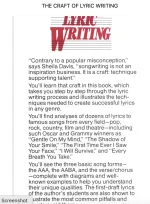
"Contrary to popular conception, songwriting is not an inspiration business, it is a craft, technique supporting talent”. -Shelia Davis.

Screenshot 2025-05-23 at 1.34.41 PM.webp

The book seems well suited towards professionals writing songs on demand to external requirements, say for advertising, Nashville publishing houses, or Broadway shows. And the OP description of the rigorous New School Class, writing to titles assigned by the teacher, endless drafts, checklists, and so forth just kind of makes the book seem like a boot camp approach. I also believe in inspiration, and will never give up on the power of it, even though it is true that it isn’t 100 percent reliable or “industrial strength”. I’ve found the best art to be inspiration tempered with craft and experience. So that statement from the author seems like a half truth, and it rubs me the wrong way.

That being said, this doesn’t mean I don’t appreciate your sharing it, that it has helped your lyric writing, and broke the ice for discussion too.
 
Last edited:
Adversity and painful emotions are some of the best songwriting fuel (unless you're Jimmy Buffett :giggle:).

I always loved this lyric by Waylon & Willie, because it so perfectly encapsulates the songwriter's mindset of seeing the potential for a song in every one of life's experiences, especially the negative ones:

Always send a big guy for the money
Don't give 'em no excuse to do you wrong
Even when you lose, you're still the winner
At least you've got the makin's of a song


About 15 years ago, I experienced a sudden burst of inspiration that resulted in about a dozen songs over a period of a few months. At first, I didn't understand why I was writing so fervently, but after I gained some distance, I realized what was happening.

A dear old friend had recently moved back to my local area after living in another country for about 25 years. As we reconnected and caught up on each others' lives, I learned that he was having a pretty tough time of it - his business failed and drove him to the brink of bankruptcy, his marriage was on the verge of falling apart, his teenage son was in serious trouble with the law, another had substance abuse problems, his mother was recently diagnosed with dementia, and he was going through some heavy conflicts with his contentious siblings.

It tore me up to see all the suffering he was going through. I supported him as best I could, but I was powerless to affect any meaningful change in his circumstances. So... I ended up doing what any songwriter does, I channeled his painful experiences into songs. They came fast and furious. Every time he reported a new setback or family problem, a few days later, a new song would emerge through no real deliberate effort on my part. And they weren't simply throwaway tunes - many are among my enduring personal favorites.

So whether the misery is our own, someone else's, or our reaction to someone else's, the gift we have as songwriters and artists is the ability to redirect it into something that can bring healing and self-reflection to ourselves and others. As Woody Allen wrote:

"The artist’s job is not to succumb to despair, but to find an antidote for the emptiness of existence."
 
Last edited:
I'm dispirited that I posted this and wish I hadn't. I will put it up on another songwriting forum and see what happens there.

I've never written songs without a reason. The songs have always been vehicles for what I needed to express. My girlfriend of two years walked out the door for the last time? That was good for three songs. I had to write those songs to heal myself. They were for me--hardly anybody heard them.

My folders of songs are a timeline of all the things I felt most deeply about at various points in my life.

In the case of this song, I saw a beautiful trapeze artist fall to a concrete floor when I was 9 years old. I thought she died. It's haunted me for my whole life. I'm older now, and for some reason, I felt the need to try to deal with this traumatic memory by wedding lyrics and music about it.

After I thought the song was done, I realized that much of what was in my head did not fully make it into the song. Through listening to another songwriter (Davis) and her book, which shares the thoughts of hundreds of songwriters, something clicked in me like never before. I started painting pictures. The song got a lot better.

My post was intended to share my experience of trying to write a song the best I could. I was not attempting to make a grandiose statement that told the truth about what ALL songwriting should be. There are billions and billions and billions and billions of reasons to write songs and ways to write songs. There are no rules.

It's just that for me--one songwriter--there was a way, very late in life, to get better at what I was trying to do.

We're all alone writing our songs, right? We have to follow where our creative impulses take us. What others do doesn't matter. I'm not a fool. I know professional songwriters in LA write songs in a day or less. But I write for me, and I write the way I'm compelled to do it, which takes weeks and months.

I've removed the sentence where I said I felt this book could be helpful to all songwriters.
"I've never written songs without a reason."

I write music without a reason all the time. I just start creating frequency puzzles for fun (I guess that's a reason) and see what happens. All of my music is written that way. Many end up with lyrics that have meaning, but it's not a necessity. Craft is just a starting point, not the destination.
Steve Lawrence years ago used to read song lyrics without the music. They mostly sounded as dumb as you'd expect, but add the music and magic happened.
I guess my problem with books like this is they stifle imagination with too many "rules on how to".
 
I write music without a reason all the time.
Your way of writing songs is what suits you best. I don't have any choice about how my songs come about.

I love Paul Zollo's "Songwriters on Songwriting" books. He interviews Dylan, Paul Simon, Pete Seeger, Laura Nyro, Randy Newman, Joan Baez, David Byrne, Tom Petty, Lou Reed, Mark Knopfler, Jimmy Webb, Burt Bacharach, Merle Haggard, Leiber and Stoller, Herbie Hancock, Paul Anka, Aimee Mann, Donald Fagen, James Taylor, Rob Zombie, Sia, Madonna, Brian Wilson, John Prine, Stephen Stills, Kris Kristofferson, John Sebastian, Loretta Lynn, Patti Smith, Elvis Costello, Chrissie Hynde, and many dozens more. And guess what? They all do it differently. There's no set way.

This is my road. This is the only way it is possible for me to write songs. And that's the beautiful thing. None of those people can write my songs either. They didn't live through my life and my stories and they don't think the same way I do about life. And we're all different in terms of the way we join our lyrics to melodies, rhythm, and chords.

Whether anybody ever listens to our songs, trying to write them as well as we can is what makes us human.
 
Thank you @Reid Rosefelt for starting this discussion. I found it interesting and useful. When I took a songwriting class, they taught similar to your feelings on songwriting. It needs to tell a story and move forward to some resolution. But, as a singer, I also understand @Tim Nash's thoughts that a good melody can cover for bad or non-lyrics. At least in the pop/rock songwriting area.

I think in country, folk, pop/rock ballads and definitely things like musicals, a story really matters. But for some songs, it doesn't really matter. Considering how many times people don't even know the correct lyrics on songs but still love to sing along with the wrong lyrics, I think it's the emotion you get from a song that matters the most. Whether the emotion comes from the music, lyrics or both, I am not sure it matters.

And? I ordered the book, though I got a used version. It is always good to learn to be better.
 
Thank you @Reid Rosefelt for starting this discussion. I found it interesting and useful. When I took a songwriting class, they taught similar to your feelings on songwriting. It needs to tell a story and move forward to some resolution. But, as a singer, I also understand @Tim Nash's thoughts that a good melody can cover for bad or non-lyrics. At least in the pop/rock songwriting area.

I think in country, folk, pop/rock ballads and definitely things like musicals, a story really matters. But for some songs, it doesn't really matter. Considering how many times people don't even know the correct lyrics on songs but still love to sing along with the wrong lyrics, I think it's the emotion you get from a song that matters the most. Whether the emotion comes from the music, lyrics or both, I am not sure it matters.

And? I ordered the book, though I got a used version. It is always good to learn to be better.
I hope you enjoy the book. Mine is a used copy too. :)

I agree 100% that the melody is the most important thing. Without a banging melody, nobody is going to listen to a song written by a nobody like me, unless they are a friend and have to. And if a stranger turns off my songs after ten seconds, then any lyrics I write are moot.

When I started writing songs as a teenager, the first melody I wrote was the last. And that continued until recently. I revised the lyrics, but I just jammed them into the existing melody. Now I start from the place that my melodies can always be a lot better--I just have to experiment with how.

A lot of melodies, even big hits, are horizontal: just the same 2-3 notes repeated over and over. A strong chord progression can mask that. I think that often the hook is the arrangement or lead line (think "Call Me Maybe" or "Satisfaction"), more than the core melody.

And some of what I'm searching for in my melodies isn't increased catchiness--it's looking for more ways for the music to tell the same story as the lyrics do. (Some call it "prosody") When my trapeze artist falls from her trapeze (in the song I'm talking about in this thread), the notes sung on the word "fall" descend five steps down the scale.

I think the idea of what a story is in a song is debatable. Most songs don't tell "stories" like a TV show does, but they do build and leave you feeling something--what Davis calls a "payoff." It just happens that I do try to tell conventional stories in my songs, but I don't need any help from a teacher like Davis for that--it comes pretty naturally to me at this point in my life. (Among other things, I've written ten feature screenplays--storytelling is something I have thought about a lot over the decades.) If I can't find a great ending, then I don't bother. It's like telling a joke without a punchline. The ending is the driving reason to write the song--I want to lead people there and get some kind of response.

I think for songwriting it comes down to what songs you like to listen to. Your taste. And then what's possible for you to write. I admire Joni Mitchell to the moon, but so what? She is billions of miles beyond anything I can dream of becoming. But I can learn from her. I can appreciate the playful games she plays with words ("bows and flows of angel hair") and try to do something similar in my own way, with my own abilities. I've studied Lorde, so I know she employs metonymy in almost all her song lyrics. Maybe I have used that in some of my songs, without knowing what metonymy was-- I have no idea. But it's on my mind now for something I want to consciously experiment with. Because I love Lorde's songs so much. It's like learning how the magic tricks are done.

On this song, I finally learned the concept of "show, don't tell," which is a real basic ABC idea. I don't know how I got so old without grasping it--but the continuing chase for all the things I don't know is what keeps me going.
 
Back
Top Bottom