
×
What's new

What do I owe the people I write songs about?

Reid Rosefelt

Well-known member
I am working on an album now which will be completely songs about women. Some of them are women in my life, some of them are fictional, but some are real women I've never met.

For two of them, I read about them and then wrote my own song. Took a few things I learned and then I used my imagination and put myself into them.

But I also have a song about Suze Rotolo, who was Bob Dylan's girlfriend. She can be seen on the cover of "The Freewheelin' Bob Dylan," he writes about her in "Chronicles," and she is in Scorsese's "No Direction Home: Bob Dylan" documentary. The character played by Elle Fanning in "A Complete Unknown" has nothing to do with anything about her, in my opinion, except being on the "Freewheelin'" album. Dylan gave complete approval on the script of the film, with only one change--that character could not be called Suze Rotolo. Because she really wasn't at all. I"m cool with the character, because like so many things in the movie, there are numerous things in the movie that are untrue, but contribute to a story that I think is essentially true. Elle Fanning is a terrific actor and her fictional character was necessary to the fictional construct they put together to tell the story of Dylan in a short period of time.

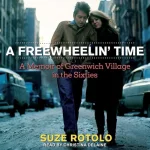
What makes my Suze Rotolo song different is that she wrote a book, "A Freewheelin Time: A Memoir of Greenwich Village in the Sixties." She's expresses herself very poetically, and I've used her words all over the place. The title of my song is "Not a String on His Guitar." Her words. I wouldn't have thought that up.

I do have a mutual friend with her family (she thanks him at the end of the book). My strong instinct is to approach my friend with the song and ask him to take it to her son Luca. I want to offer a share in profits that come from the song. Not the copyright, but some profits I've spent a lot of time writing the song, copyright fees, I'm going to hire a singer and a mixer to get it ready for streaming, but I don't expect to make five cents on it. It's not particularly generous for me to offer a share of my nothing.

On the other hand, if the song does well it will be partly due to the fact that certain people care deeply about her. Not to mention her beautiful words that I am using. So if the song makes money, then she earned it, in my book, even though I wrote it and laid out a lot of money (for me) to get it up on Spotify, etc.

It's quite possible that if I did that, Luca would not like the song at all, and that could open up a can of worms. My opinion of Dylan is different from Suze's. She was an artist in her own right and didn't want to be known as his muse. She thinks he was a genius, but not a good person--so she had to leave him. But she was a better person than I'll ever be and her final note is that she got as much out of him as he did out of her. (That's in my song.)

I'm a darker person and more judgmental. I don't see any sign that Dylan ever gave one second of thought to the Civil Rights movement before he met her. She was born a "red-diaper baby," a child of Communists, and she spent every day marching and working for Civil Rights and other causes. She was a true believer. She never stopped fighting for social justice for the rest of her too short life. He was a brilliant cynical careerist. He was living with her every day, and suddenly the Buddy Holly fan became the "Voice of a Generation." After Suze left him, I think Dylan pretty much dropped that kind of protest music forever. I stopped listening to him, so I can't say for sure. Maybe "Hurricane."

There's more to the story than that, of course. He came in to New York loving all kinds of music and every night he could go into a club and play any kind of music he wanted--as long as it was folk music. He loved folk music, he idolized Woody Guthrie, so it wasn't hard for him to be a folkie for a while. Suze's sister Carla, was the assistant to Alan Lomax, so this gave him special access to one of the greatest treasure troves of folk music. But subsequent history shows the diversity of the music Dylan liked.

I love Dylan's music, and he was everything to me in my teens, but today I see Dylan as a brilliant bullshitting careerist, and very mean to people, particularly Suze, who he publicly cheated on. I think a lot of what he became came from Suze Rotolo. She introduced him to Rimbaud and Brecht, and that got into the development of his music. He wrote some of his best songs about her, including "Don't Think Twice," "Boots of Spanish Leather," and "Tomorrow is a Long Time." And of course, maybe his worst song, "Ballad in Plain D," about their breakup. (Dylan has since said, "I look back and say 'I must have been a real schmuck to write that.' I look back at that particular one and say, of all the songs I've written, maybe I could have left that alone.")

But I strongly dispute that he only wrote the songs that are commonly seen as Suze Rotolo songs. I see her in all kinds of songs where Dylan puts a great woman on a pedestal, like "Love Minus Zero: No Limit." It is my opinion that Dylan never stopped writing songs about Suze Rotolo and never stopped loving Suze Rotolo. I see her face when I hear "Sad-Eyed Lady of The Lowlands" (bullshit it's Sarah Lownds) and in the female characters in "Blood on the Tracks." She was the love of his life and when she left him, he never recovered. Luckily, Dylan wasn't the love of her life and she found happiness with Italian film editor Enzo Bartoccioli.

But Suze probably wouldn't have liked what I just wrote. Luca probably wouldn't either. He might not want to be connected to my song. But if I offer him a share at least he couldn't say that I didn't respect her contribution and want to compensate her family for that.

But my song isn't journalism. In the insanely unlikely possibility that the song attracts attention, it could spark somebody else to write about her or make a movie about her. Which she so amply deserves, in my book. And my song is way more accurate than the Elle Fanning character.

Your thoughts? Do you think I am making a mistake by wanting to approach Luca? The only thing I'm afraid of is that they would somehow try to stop me from releasing the song, which I don't think they can do. She is a public figure. And I love her, if you haven't been able to tell by what I've written above. I wish I'd known her.
 
Last edited:
IANAL, but I don't think there's need to get permission from the family/estate.

As you noted, Suze is/was a public figure. The words you are quoting are fair use, as your work is both transformative and a commentary. Although there is no guideline as to the number of words you can use, the length of the quotes are relatively short. Rather than diminish the value of Suze's book, they are more likely to add value, as a listener would be interested in getting a more complete version of the story.

As for the title "Not a String on His Guitar", the use is transformative, and doesn't infringe in any way on the author's estate to make make money on the book. If it were the title of the book, that would be a different matter.

Our lives are enriched by the people around us, and it makes sense to want to give back to those people. If the song does become hugely popular, you can always choose to give some donation to her estate even though there's no legal obligation to do so.
 
IANAL, but I don't think there's need to get permission from the family/estate.

As you noted, Suze is/was a public figure. The words you are quoting are fair use, as your work is both transformative and a commentary. Although there is no guideline as to the number of words you can use, the length of the quotes are relatively short. Rather than diminish the value of Suze's book, they are more likely to add value, as a listener would be interested in getting a more complete version of the story.

As for the title "Not a String on His Guitar", the use is transformative, and doesn't infringe in any way on the author's estate to make make money on the book. If it were the title of the book, that would be a different matter.

Our lives are enriched by the people around us, and it makes sense to want to give back to those people. If the song does become hugely popular, you can always choose to give some donation to her estate even though there's no legal obligation to do so.
I know you're right, David. I have every right to write the song and put it out into the world.

What I'm wrestling with here is not that I have some kind of obligation--it's something I'd like to do. But I've done a lot of stupid things in my life that blew up in my face. Trying to do something good and just getting somebody pissed off. I have no idea what kind of person her son is, or what he might do to condemn or try to block my song in some way once he became aware of it. On the other hand, with the utter oblivion of Spotify and other streaming services--it's unlikely he'd ever become aware of the song's existence. Unless he's in the habit of checking out a hundred thousand songs a day to see what's up in the music world.

Maybe it's better for my safety to not try and do this nice thing. No good deed goes unpunished.
 
This doesn't address your conundrum directly, but let me begin by sharing some brief thoughts relating to my own songwriting experiences...

Whenever I come up with what I think is a clever or unique line, it's practically become an automatic reflex for me to do a lyric search to see if that line has already been used in a song. And if I find a match, then more often than not, I will alter my lyric.

I fully realize it's probably okay for me to use the line, but I'd rather err on the side of caution and not tempt fate. Copyright lawsuits around songs are a common thing these days, no matter how legit or frivolous they actually are, and even if I win, the process of defending myself and proving fair use can be costly.

Yes, I realize nobody's going to care about or notice my songs unless by some extremely unlikely miracle they become popular and earn a lot of money, but since I'm mostly writing songs for licensing nowadays, there's the potential for them to appear in a movie or on TV, and that could be enough visibility to make them a target.

For songs that I write for personal creative expression, I'm less concerned, but I still check if the lyric has been used before, and depending on how visible or recognizable it is, may alter my lyric.

Okay, enough about my personal stuff. Now on to your specific situation...

The desire to share your song's profits with the Rotolo estate is a noble one. My only concern is that it could potentially open a messy can of worms. If the estate becomes aware that you've quoted Suze's book throughout your song, they may feel, rightly or wrongly, that they have a claim to a portion of the song's copyright. If they seek legal counsel, it could potentially take things down a thorny path.

This is really not so much about whether or not you have the right to use lines from the book in your song, but how the estate will react to such use, and the resulting consequences, which is not something you can necessarily predict and could end up being a huge headache.

To minimize the chance of potential complications but still honor Suze's spirit, you could instead, choose to donate a portion of the song's profits to a cause or organization that Suze was passionate about.


In the realm of copyright law... I found this informative and rather thorough article that might help shed light on the copyright aspects of your situation. This article is about quoting copyrighted works in a novel, which is slightly different, but many of the examples and legal points the author discusses should also apply to song lyrics:

Jennifer Haskin: Can I quote another book poem or song lyrics in my novel?

Good luck and keep us posted on how you decide to proceed.
 
This doesn't address your conundrum directly, but let me begin by sharing some brief thoughts relating to my own songwriting experiences...

Whenever I come up with what I think is a clever or unique line, it's practically become an automatic reflex for me to do a lyric search to see if that line has already been used in a song. And if I find a match, then more often than not, I will alter my lyric.

I fully realize it's probably okay for me to use the line, but I'd rather err on the side of caution and not tempt fate. Copyright lawsuits around songs are a common thing these days, no matter how legit or frivolous they actually are, and even if I win, the process of defending myself and proving fair use can be costly.

Yes, I realize nobody's going to care about or notice my songs unless by some extremely unlikely miracle they become popular and earn a lot of money, but since I'm mostly writing songs for licensing nowadays, there's the potential for them to appear in a movie or on TV, and that could be enough visibility to make them a target.

For songs that I write for personal creative expression, I'm less concerned, but I still check if the lyric has been used before, and depending on how visible or recognizable it is, may alter my lyric.

Okay, enough about my personal stuff. Now on to your specific situation...

The desire to share your song's profits with the Rotolo estate is a noble one. My only concern is that it could potentially open a messy can of worms. If the estate becomes aware that you've quoted Suze's book throughout your song, they may feel, rightly or wrongly, that they have a claim to a portion of the song's copyright. If they seek legal counsel, it could potentially take things down a thorny path.

This is really not so much about whether or not you have the right to use lines from the book in your song, but how the estate will react to such use, and the resulting consequences, which is not something you can necessarily predict and could end up being a huge headache.

To minimize the chance of potential complications but still honor Suze's spirit, you could instead, choose to donate a portion of the song's profits to a cause or organization that Suze was passionate about.


In the realm of copyright law... I found this informative and rather thorough article that might help shed light on the copyright aspects of your situation. This article is about quoting copyrighted works in a novel, which is slightly different, but many of the examples and legal points the author discusses should also apply to song lyrics:

Jennifer Haskin: Can I quote another book poem or song lyrics in my novel?

Good luck and keep us posted on how you decide to proceed.
Thank you so much for this.

Here is what I'm going to do. I'm not going through with hiring the singer. I will produce the song with a Synth V voice. This is a Dylan era song so the accompaniment will either be me playing the guitar alone, or at most, me occasionally playing my bass too.

I'll copyright the Synth V version of the song. Then I'll approach my friend and give him an MP3 to share with Luca. If they are going to attack the song and try to block it, I'll drop the song. It can join all the other songs I've written that are in the trashbin. It's not that big a deal. At this moment I have 15-17 ideas for songs on my album. I can afford to lose this one. Big deal. The only important thing is the joy of writing the song. I've had a lot of fun writing this--poking fun with Dylan, and giving tribute to somebody I really admire. Whether nobody hears it on Spotify, etc. or nobody hears it at all is no big whoop. It's a success to me.

Luca doesn't have to give me his blessing. Just tell me he won't go on the warpath about it. I can't afford to donate money to a charity, but if the song makes money for him, he can spend it any way he sees fit.

I hope to have an EP up as soon as November. I'd say October, but so far, dealing with Fiverr singers has been an absolute nightmare, and nothing is getting done. (Maybe a subject for another post.) Tom Brusky @Polkasound hasn't had any problems hiring singers, as far as I know, but he is smarter than me. I am writing songs now with limited range so that I can sing them myself! Which makes me really mad. Yuck! I'd like to write any note I can think of. I do have some friends that can sing well, including some pros, so I may lean on them. And pay them, of course.

Once the EP is up, I will gradually put up more songs until it is an album. Most of the songs are written, but they have to be produced and mixed. There are only two fully arranged songs that I've sent to singers. I'm hiring a mixer--I hope these online mixers aren't as bad as the singers! Anyway, plenty of time to add or not add "Not a String on his Guitar."

I'd like to add another question to this discussion. If you were me and had decided to offer sharing to Luca, what would you share? Streaming income from LANDR? ASCAP? SoundExchange? I have a friend who only shares SoundExchange with singers, but this is different. I don't want to provoke any discord with Suze Rotolo's family.
 
Here is what I'm going to do. I'm not going through with hiring the singer. I will produce the song with a Synth V voice. This is a Dylan era song so the accompaniment will either be me playing the guitar alone, or at most, me occasionally playing my bass too.
You might try singing it yourself, and then importing it into SynthV. Sort of like using Melodyne, only without the artifacts after you edit the vocals.
 
You might try singing it yourself, and then importing it into SynthV. Sort of like using Melodyne, only without the artifacts after you edit the vocals.
I'm not going to have any Synth V vocals on my album. I use Synth V only for guide tracks. It's either me or other singers.
 
I'm not going to have any Synth V vocals on my album. I use Synth V only for guide tracks. It's either me or other singers.
Yeah, I meant as a guide track. In theory, it's easier than drawing in notes.

I wonder how many people use it as an input method, though.
 
Tom Brusky @Polkasound hasn't had any problems hiring singers, as far as I know, but he is smarter than me.
I'm pretty sure I is not more smarter then you.

Believe me, I've had my share of problems with singers and musicians over the years. Sometimes I caught them early, but sometimes I caught them too late. Back in the day, I found a lot of talent through Craigslist. I met a lot of wonderful singers this way, but I also dealt with some real knuckleheads:
One girl blew a gasket when I respectfully thanked her for replying to my ad, but told her that her voice was, stylistically, not the right fit for my song. She read me the riot act. "Who the hell do you think you are? Quincy Jones? I got the talent and the voice! Your loss!"
Then there was the guy I hired to sing bluegrass harmonies. He had ample time to practice the song but instead came to the studio expecting to wing it, and it was a complete disaster. I sent him home. There have been other unprepared musicians I've had to can from recording sessions over the years because they assumed they could wing everything.​
One singer was so negligent with prompt communication that I let him go and hired someone else. the singer was pissed, but it turned out to be one of the best decisions I ever made because the guy who replaced him was phenomenal.​

My experience using SoundBetter has been positive overall, but it has come with occasional glitches:

A semi-famous vocalist I hired for a Christian single a few years ago took about two months to deliver her tracks. In between accepting the job and delivering her tracks, she literally moved to another state. (My patience paid off in the end, though. She slayed the vocal.)​
There have been at least two times I requested and received a refund due to a vocalist's inability to deliver. And there have been times a vocalist simply never replied to an inquiry. Fortunately the staff at SoundBetter are understanding about these types of things and easy to communicate with, and it's one of the reasons I keep going back.​
Anytime you use a talent service like SoundBetter, it's going to be hit or miss, but I've experienced far more hits than misses.
 
Fortunately the staff at SoundBetter are understanding about these types of things and easy to communicate with, and it's one of the reasons I keep going back.
Anytime you use a talent service like SoundBetter, it's going to be hit or miss, but I've experienced far more hits than misses.
Do you get to communicate with real people at SoundBetter?

Most (and maybe all) of the customer service at Fiverr seem to be AI. I can't say if I have had any contact with a real person. There are rules and they give them to me. "He wrote you today and said he would deliver today." Totally true. He wrote and said he would deliver. But he didn't.

The way the system works is there is no place where an evaluation of the actual work happens. So if he sent me a blank track or a recording of dogs barking, then they would say I had the right to ask for revisions within a limited time. But he wouldn't have any deadline on making them. But if he doesn't do them at all, it just moves on to the next stage of the Kafkaesque play. I sent them copies of what I asked for, his written agreement to do it, and what he turned in, where there wasn't one note the same. The system doesn't figure this kind of thing in. He says he will turn the job in. You have 24 hours to offer revisions. At a certain point the job is considered complete, and that's it.

Today (Sunday) he sent something in at 4:41. For a lot of reasons, I won't be able to listen to it until 11 am. The clock starts at 4:41 am. It would be cool if his track was something anywhere close to what I can use. I don't mind spending a day or two in Melodyne. I have almost no hope that it will be close enough to fix, but anything is possible. But now I hate this guy so much I know that, if I did use it, it would pain me every time I hear it. But that's life I guess. Live and learn. I did start this nightmare because I love his voice and wanted to hear it sing my song.

I am in a defensive posture now. I'm trying to write some songs that I can sing. Which goes against the kind of melodies I want to write. The whole point of Synth V + performer is that you can write whatever you can dream up. (I want to write about my process in the brand new Songwriter and Producer subforum on Virtual Singers.) There was a song I wrote for alternating male and female singers. That's how it was conceive, it's worked out that way in Synth V and I like it that way. But I'm going to change it so that I can have forum member Josie Day sing the whole thing. I am confident that she will be a professional.

No more Fiverr for me. Everything will be Soundbetter. I may try AirGigs if there is somebody with a zillion positive reviews. Tip: Do not hire people without many reviews even if they have the voice you want more than all the others. It's like Amazon.

I'm thinking for the first time about hiring friends. I know some great singers. But it can be complex to hire your friends when you want to ask for changes. I wanted to avoid that by hiring people who are offering their services. I have a friend I played in bands with when I was a teenager. We were best friends at that time. Great voice. He became the singer in Badfinger and all kinds of other impressive things in his career. Now he's touring as the lead singer with the latest iteration of a famous band. If he sings for me, it's a favor, not a job. We are friends today and I don't want to screw that up. But I think I'm going to take that risk.
 
"Not a String on His Guitar" is a killer line. You gotta use it. My opinion is the same as David's, that it's squarely in Fair Use territory. (Although I'm not a lawyer, either. IANALE, for short. ;) )

Courts overall have been pretty pro-artist when it comes to allowing artistic creativity. For an extreme example, the Supreme Court ruled that 2-Live Crew's song "Big Ugly Woman" was a Fair Use commentary on Roy Orbison's "Pretty Woman." I can't remember whether Andy Warhol was ever sued for his Marilyn Monroe or Campbell's Soup Can paintings, but I think scholarly discussions have speculated that if he were sued, Warhol would win, even though his works were clearly derivative.

Anyway, even if the line (as well as the entire subject) was legally risky (I can't imagine it is, but just for the sake of argument), I would still use it, just because it's such a killer line,. I'd even make it the title.

Don't weaken your song, just for the sake of not stepping on toes. Say what you want it to say, with no compromise. (Drawing the line at character assassination, of course, which is obviously not your intention.) Make it something you're proud of, without disclaimers of "Well, I had to change this line because ..."

And then ... let's HOPE that the song has enough impact that you get sued! How cool would that be? Seriously! Again, even if it sold well, my opinion is you have nothing to worry about, but speaking for myself, I'd love, love, love to have written a song that made enough of a splash to have that sort of discussion around it. Even if I wound up not making a nickel from it.

I definitely wouldn't reach out to the family, by the way, and I definitely wouldn't offer a cut. There's a slim chance that conversation would be a positive one, but there's a huge chance it would be a disastrous one, with threatening letters from opportunistic lawyers and all that stuff. Basically totally fucking up your process of trying to write a great song. As the old saying goes, "It's better to ask for forgiveness than permission."

Warhol didn't ask permission, and the art world is better for it IMO, so I'll take my cue from him.
 
Update. Fiverr cancelled the order. I don't have to waste time downloading and listening to the track he sent in. I have zero curiosity about it. It's just so great to be rid of him.

I will find somebody on SoundBetter. It will cost more, but, if they have 1000 positive reviews, I bet there will be less hassle. And it will Sound Better.
"Not a String on His Guitar" is a killer line. You gotta use it. My opinion is the same as David's, that it's squarely in Fair Use territory. (Although I'm not a lawyer, either. IANALE, for short. ;) )

Courts overall have been pretty pro-artist when it comes to allowing artistic creativity. For an extreme example, the Supreme Court ruled that 2-Live Crew's song "Big Ugly Woman" was a Fair Use commentary on Roy Orbison's "Pretty Woman." I can't remember whether Andy Warhol was ever sued for his Marilyn Monroe or Campbell's Soup Can paintings, but I think scholarly discussions have speculated that if he were sued, Warhol would win, even though his works were clearly derivative.

Anyway, even if the line (as well as the entire subject) was legally risky (I can't imagine it is, but just for the sake of argument), I would still use it, just because it's such a killer line,. I'd even make it the title.

Don't weaken your song, just for the sake of not stepping on toes. Say what you want it to say, with no compromise. (Drawing the line at character assassination, of course, which is obviously not your intention.) Make it something you're proud of, without disclaimers of "Well, I had to change this line because ..."

And then ... let's HOPE that the song has enough impact that you get sued! How cool would that be? Seriously! Again, even if it sold well, my opinion is you have nothing to worry about, but speaking for myself, I'd love, love, love to have written a song that made enough of a splash to have that sort of discussion around it. Even if I wound up not making a nickel from it.

I definitely wouldn't reach out to the family, by the way, and I definitely wouldn't offer a cut. There's a slim chance that conversation would be a positive one, but there's a huge chance it would be a disastrous one, with threatening letters from opportunistic lawyers and all that stuff. Basically totally fucking up your process of trying to write a great song. As the old saying goes, "It's better to ask for forgiveness than permission."

Warhol didn't ask permission, and the art world is better for it IMO, so I'll take my cue from him.
"Not a String on His Guitar" is the title and the chorus. Suze is all over this thing. She calls herself a "red-diaper baby," which means she was the child of Communists. The first line of the song is "I'm a red-diaper baby from the Kingdom of Queens."

However, she or her family didn't write the melody or 95% of the lyrics. Her family didn't give the song a structure or arrange and produce it. As I said, she probably wouldn't agree with it, and I put words in her mouth. The way she/I describe Dylan in the song is, in my opinion, very funny. But my sense of humor, not hers.

It is a work of imagination that borrows certain things she said in her book. I think her life is fair game, but I don't know about her words. I'm not stealing her book. Just a few words here and there. There are probably tons of people who talk about red-diaper babies. It was a commonly used term, not something she invented.

I can't defend myself from a lawsuit! Even if you win, you lose. That sounds like the kind of thing I have done so often. Work hard on something for months or years and end up broke. I've lost all my money so many times. I am so lucky that I have made it to retirement. I always survived, but I don't want to do that to my wife just to write a song that will fall into the infinite Volcano hole of Spotify.
I definitely won't make a dime, but maybe my wife and I could lose our apartment and our savings! What a deal!

But you're right, Mike. There's no safe space except for not putting out the song. Damned if you do. Damned if you don't. Approaching the family could blow up in my face.

I'll spend the money and produce it and then put it up here and on other songwriting forums. Send it to lawyers. Get some feedback before it goes up on Spotify.

The song is about how I think Suze is magnificent and how I think Dylan was an asshole. She definitely agreed with me to a certain extent, because she left him. And she spells out why. Not a nice man. A baby with a black hole of need. She had to mother him endlessly and he would reward her by letting the world know he was screwing Joan Baez. And others. And writing songs about her that sometimes were also not nice, like "Don't Think Twice" and "Ballad in Plain D." Some beautiful ones too. But who was he? A snide poseur who lied about himself. Rude. Full of himself. He and that shit Bobby Neuwirth walked around being nasty to people for fun. She sees this stuff, but is more gentle in her critique. She loved him. I have a more jaded attitude. I loved him too, but I didn't know what he was like, and was very disappointed when I learned more.

But she said she got as much from him as he did from her and that is in the song.

My song is a little bit different from her reality, but not tremendously far. And it is motivated from my love and admiration for Suze Rotolo. Okay, also from me wanting to say I think Dylan was a genius, but also an asshole.

If it was about him and not her, I could call it "The Asshole Who Was a Genius."

Gonna keep working on this one. I will be making a brief video on every song on the album, so I will be able to address all these issues.
 
Last edited:
Also "fair use" is a term that is vague and needs to be defended in court. You can follow all the rules of Fair Use and somebody can still sue you. And then you're paying lawyers.

I remember there was a press event I wanted to put on at Sony, which involved showing clips from movies from various studios. While I was prepping that, I happened to sit on an airplane with a lawyer who specialized in fair use litigation. She told me that beyond a doubt what I was doing was fair use, because I was using the clips to make an argument. I wasn't just randomly showing them. The Sony lawyers still would not let me do my press event. They didn't care that it was legal, they came from a point of "maybe somebody will come after us anybody, and we're a big target." In time I realized that whenever the Sony Classics execs asked me to call legal, I would always be turned down. My theory is that they worked from the idea that if somebody was worried something might not be kosher, that was reason enough to say no.
 
I can't defend myself from a lawsuit! Even if you win, you lose.
You don't get sued unless the song is a hit. At that point, you'd have the cash to fight it.

Plus, one rule about copyrights (in the U.S.) is that the judge can award attorney fees to the winning party. This would be such a weak case on their end that no lawyer worth his salt would recommend prosecuting it, because the risk on their end would be so high.
 
This thread has been very helpful to me. I read Rotolo's book again, and really tried to listen to what she was saying. I threw out all the verses except the first one. The whole point of "Not a String on his Guitar," is she didn't want to be seen just as Dylan's muse or chick. She had her own artistic ambitions.

Also, she paints a vivid picture in the book of what it was like to be a young person living in Greenwich Village in the early 60s. The people, the places, how people thought. That’s why it’s called “A Freewheelin’ Time” and not “Bob and Me.” But she had the same problem with the book that I have with the song: the cover is her hugging Dylan on the album cover of “The Freewheelin’ Bob Dylan. Dylan casts a big shadow. Everybody wants to know what he was "like."

It reminds me of a sad story in the book where a friend of Suze's was telling her about something nice that somebody had said about her. Suze could not consider the possibility of that person actually liking her for who she was. If a stranger wanted to know her, in her eyes it was always to get to Dylan.

IMG_0151.webp

Making the song be all about Dylan, even if I was praising her for the massive impact I believe she had on him as an artist, was still making a song about how she was Dylan's girlfriend.

Rather than worry about whether I'm using too many of her words, I'm just trying to sincerely rewrite it from her point of view.
 
Last edited:
Yeah, I meant as a guide track. In theory, it's easier than drawing in notes.

I wonder how many people use it as an input method, though.
I finally tried it. Not only does it capture the notes, you have the option to have it capture the phonemes too. It rarely gets the correct spelling of the words, but it sounds a lot like what I sang, which is kind of amazing. Even though the typed words are nonsensical, I don't always change them, because they sound fine.

The only thing is it doesn't often get the notes and timing exactly right. But it still provides a good starting point. It also produces wacky pitch envelopes that require a lot of editing.

But overall I think this is the fastest way to input my songs into Synth V, and it's what I'll use going forward.

I would say to non-singers, even if you just spoke the lyrics, or sang one note, you'd get all the notes in with the words--and then you can make your melody from that.
 
Back
Top Bottom